
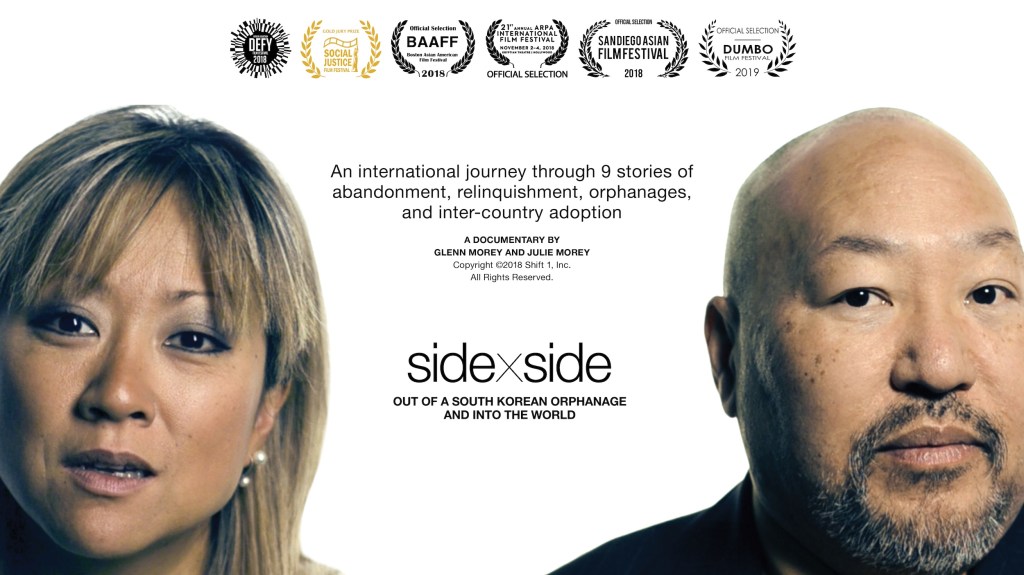
What happens when the lives of children are re-set by adoption? Sent to grow up in new countries and families of a different race, language, and culture? This short film presents the stories of 9 Korean-born, inter-country adoptees—filmed in Seattle, Chicago, Boston, New York City, Paris, Stockholm, Amsterdam, and Melbourne.
Stories of a baby violently thrown from a car at an orphanage front door. Being given away to a total stranger in a train station. Feeling like a “Martian” and bearing the identity issues of being gay and a Korean-American adoptee. Reuniting with birth parents and trying to make sense of relationships with mothers and fathers they’ve never known.
The Side by Side project starts in the 1950s, during and after the Korean War. At the time, two million infants and children had been orphaned or somehow separated from their families of origin: Rounded up from the streets, found abandoned in doorways, police stations, and churches. Distributed to orphanages, to live side-by-side in rows of sleeping mats, boxes, and cribs.
It didn’t end there. The steady stream of homeless children continued unabated through the post-war decade, the many years of political and social instability, the early growth, the IMF bail-out, and even through massive development and international expansion into a global economic force. Still, they were abandoned and relinquished into orphanages, the human consequences of hunger and poverty, social stigma and racial bigotry, broken marriages, and untimely death.
Out of millions, some 180,000 were plucked from the orphanages and adopted out, primarily to wealthy Western countries. Most “aged out” to face the challenges of living in Korea without a family. Others died in the orphanages or on the streets. The random chaos of the universe. In its fullness.
64 years ago, Glenn Morey was an orphan in South Korea. As a days-old infant abandoned on the streets of Seoul, he was processed through City Hall and placed in an orphanage. Six months later, chosen from a photo, he became the first son of an upper-middle class family of five, living in the suburbs of Denver, Colorado.
Ten years ago, he and his creative partner and wife, Julie Morey, started filming interviews. They started in South Korea, with eleven ROK nationals who had aged out of orphanages. From there, they filmed interviews with adopted Koreans in eight U.S. cities coast to coast, then on to Stockholm, Copenhagen, Amsterdam, Paris, and Melbourne.
Over the course of 3 years, 7 countries, 6 languages, and 16 cities, they acquired the first-person narratives of 100 orphans and “social orphans” born in South Korea since the 1950s—a diverse representation of millions of infants and children who were somehow separated from their families of origin, institutionalized in orphanages and the foster system.
They approached every interview in the same way—loosely structured, first-person narrative sessions in which subjects told them the stories of their lives. In roughly chronological order, subjects described what they remembered or what they’d been told about their origins in South Korea. How they were separated from their Korean families of origin. How they were adopted or aged out. How they grew up and came of age. Who they are today.
Viewers of these filmed accounts quickly understand the unimaginable disparity of these subjects—the stories of the adopted and the aged-out, the nurtured and the abused, the blessed and the broken, the loved and the lost, and the stories that lie between. They also realized what these subjects were fully prepared to give—the emotional toll of remembering love and loss, the spontaneous and sometimes searing revelations of the moment. Each session is its own filmic experience, captured as subjects drew on and relived repressed memories, connected events, finally acknowledged truths, resolution, and reconciliation.
Early on, the filmmakers became committed to the belief that somehow presenting every story they filmed was the most honest project they could create. Typically, filmmakers have to make decisions. Those decisions, especially in the editing room, result in the filmmaker’s interpretation of the topic, told through a limited number of filmed subjects. This project deserved a different approach. They wanted to find a way to include the many stories required to represent an international and largely unknown subculture, and to allow their telling to be exactly as the tellers intended. They also wanted audiences to be able to immerse themselves in this subculture, coming to know it and these storytellers intimately.
So with that, our documentary became, not a linear film, but a non-linear, highly unconventional, multi-platform project:
- SideBySideProject.com streams 100 separate filmed interviews, all of them presented very nearly in their entirety, as they were filmed in a single continuous sitting. Viewing these stories is very different from viewing a conventional movie. With every resurfaced memory, every pause, every revelation, and as every minute goes by, viewers come to know these storytellers in unexpected depth.
- The award-winning, 38-minute documentary film, Side By Side: Out of a South Korean Orphanage and Into the World. Over the course of just 40 minutes, audiences come to know nine adoptees—in Seattle, Chicago, New York City, Boston, Stockholm, Amsterdam, Paris, and Melbourne—as they face revelations about their origins and struggle to make sense of their lives.
- 10 thematic short films, provide an organized, guided tour of the 100 stories.
- An Audible Original, Given Away, features 15 stories and filmmaker commentary.
- New York Times Op Doc, Given Away.
- A 10-screen video art installation, features 10 short documentaries, a non-linear, immersive guided tour through over 5 hours of film, available for art, cultural, community, and educational institutions in the U.S. and abroad.
Side by Side filmed interviews in 7 countries, 6 languages, and 16 cities.
 Side By Side Project